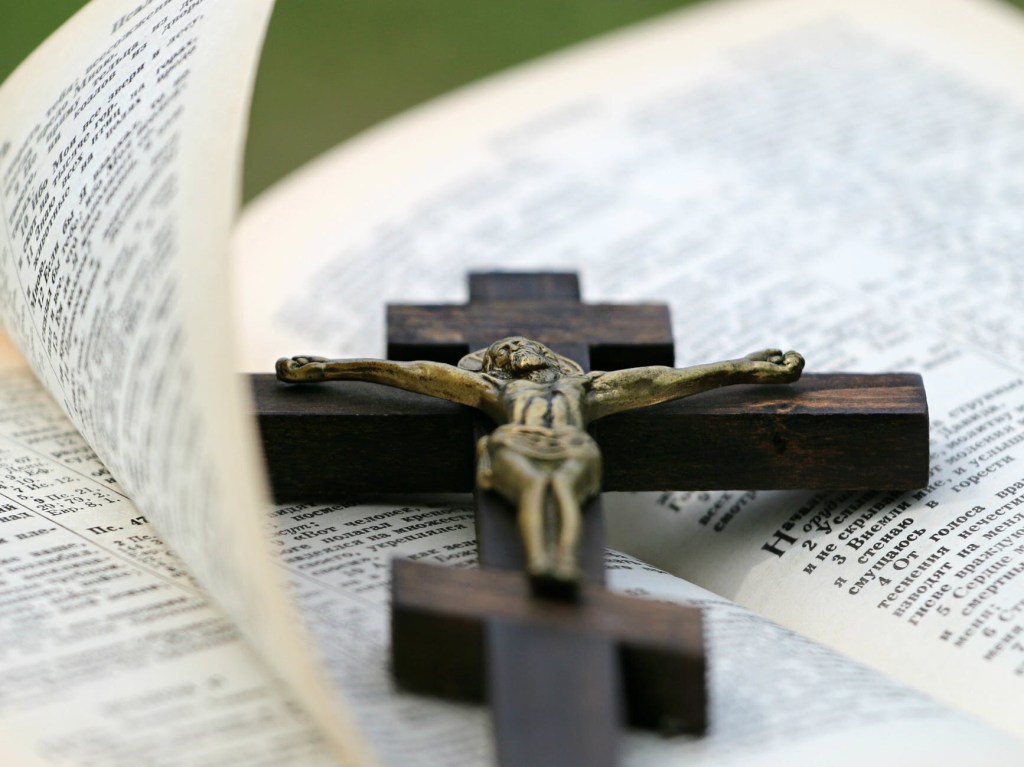
Jesus is Glorified

“And Jesus answered them, “The hour has come for the Son of Man to be glorified” (John 12:23).

During the time leading up to Jesus’s crucifixion, he spoke to his disciples about what was soon to happen. Jesus meant to prepare them for his eventual crucifixion and resurrection. Jesus spoke of being glorified in relation to his crucifixion. Jesus did not limit his upcoming experience to his crucifixion, but saw beyond this to his burial and resurrection. Jesus knew that in order to live that he needed to be willing to sacrifice his life. “Truly, truly, I say to you, unless a grain of wheat falls into the earth and dies, it remains alone; but if it dies, it bears much fruit” (John 12:24).

Jesus taught his disciples that whoever loved his own life and glorified themselves in the flesh, could never experience real life. Jesus urged his disciples to follow his example of self sacrifice and denial of self. Despite his conviction that he must lay down his life for the world, Jesus was troubled by what was ahead of him. Nevertheless, his desire was to do the will of the father who sent him. “Father, glorify your name.” Then a voice came from heaven: “I have glorified it, and I will glorify it again”” (John 12:28).

Jesus spoke also of his ascension following his crucifixion and resurrection. The purpose of which was to lead people to salvation and communion with the father. “And I, when I am lifted up from the earth, will draw all people to myself” (John 12:32). His message and mission is the salvation of the world and to draw people out of darkness into the light.

In chapter 13, Jesus spoke of his betrayal by Judas and gave him the instructions to act quickly. “When he had gone out, Jesus said, “Now is the Son of Man glorified, and God is glorified in him” (John 13:31).

A.P.-Y.

God’s Favour is a Shield

“yet your father has cheated me and changed my wages ten times. But God did not permit him to harm me” (Genesis 31:7).

In Genesis 31, Jacob decided to leave his father in law Laban and return to live with his family in Canaan. In preparation for his journey, he spoke to his wives who were daughters of Laban. Jacob recounted his experience of working with Laban who was a crafty man. Laban had changed Jacob’s wages several times and made him work double the number of years to marry his daughter Rachel.

Jacob initially fell in love with Rachel and Laban agreed to allow him to marry her after seven years of labour. On the day of their wedding, Laban tricked Jacob into marrying Leah who was Rachel’s older sister. Once Jacob found out, Laban made him work another seven years in order to marry Rachel. Because of his love for Rachel, Jacob worked an additional seven years. He also continued to work with Laban after his marriage to Rachel and agreed to be paid with the lambs that were born speckled or spotted (Genesis 29:1-30;30:25-42).

God blessed Jacob and caused him to increase. Laban continued in his craftiness and when he saw that Jacob was increasing, he would change the agreement regarding his wages. “If he said, ‘The spotted shall be your wages,’ then all the flock bore spotted; and if he said, ‘The striped shall be your wages,’ then all the flock bore striped” (Genesis 31:8). No matter what strategies Laban used, God caused Jacob to increase because he walked in the blessing of Abraham.

You are blessed of the Lord and you walk in favour. The favour of the Lord acts as a shield around you so that no one will be able to prevail against you. You are blessed and the circumstances around you cannot dictate your level of blessings.

“Blessed shall you be in the city, and blessed shall you be in the field”(Deuteronomy 28:3).

A.P.-Y.

The Intercessors’ Mantle (2)

“Then Abraham drew near and said, “Will you indeed sweep away the righteous with the wicked” (Genesis 18:23).

Yesterday we discussed Moses’s role in praying for the Israelites who God wanted to destroy. Today we will look at how Abraham also made intercession for Sodom and Gomorrah when God wanted to destroy them. In Genesis 18, God sent three angels to visit with Abraham and Sarah concerning their promise of a son. The Lord revealed to Abraham that the men were sent to visit Sodom. This was because of an outcry against that city due to their sin. Abraham started to plead with God asking him to have mercy on Sodom (Genesis 18:1-23).

Abraham took it upon himself to petition God on behalf of the people. He asked God if he would spare the city if he found fifty righteous. Abraham did not stop there but continued to ask God if he would spare the people if he found forty five righteous. Abraham then asked about forty; thirty, and then twenty. “Then he said, “Oh let not the Lord be angry, and I will speak again but this once. Suppose ten are found there.” He answered, “For the sake of ten I will not destroy it”” (Genesis 18:32).

Abraham was willing to risk the anger of God, but was determined to pray for the city to be spared. Abraham did not merely shrug his shoulders when God told him what he intended to do. Neither did he say, “the Lord’s will be done,” or say that the people were deserving of the judgement. Abraham knew that he had a say in the affairs of the city and he knew that God would listen to his request. As it turned out, God did not find at least ten righteous and the city was destroyed. At least Abraham knew that he had prayed and he knew that God had heard and considered his request.

Have you considered the state of your city and started to cry out to God for salvation? Perhaps God will find more than ten righteous and send a revival. Either way, we have a role to play in praying for the salvation and safety of those around us.

“But seek the welfare of the city where I have sent you into exile, and pray to the Lord on its behalf, for in its welfare you will find your welfare” (Jeremiah 29:7).

A.P.-Y.

The Intercessors’ Mantle

“But Moses implored the Lord his God and said, “O Lord, why does your wrath burn hot against your people, whom you have brought out of the land of Egypt with great power and with a mighty hand” (Exodus 32:11).

In Exodus chapter 32, Moses returned from mount Sinai with the two tablets of stones on which God had written the Ten Commandments. While Moses was away, the people rebelled against Aaron and asked him to make a golden image for them to worship. God was angry at the people’s response. “Now therefore let me alone, that my wrath may burn hot against them and I may consume them, in order that I may make a great nation of you” (Exodus 32:10).

Moses stood in the gap for the people and begged the Lord not to destroy them. Moses reminded God about his promise to Abraham, Isaac and Jacob, to make them a great heritage and his covenant of blessing. Moses also told God that the Egyptians might say that he had brought them out of Egypt to kill them in the mountains (Exodus 32:11-13). God listened to Moses and decided not to destroy the people.

Moses himself was furious with the people when he arrived at the camp and saw what they were doing. Insomuch that he threw down the tablets which he carried and broke them. There were other instances when the people tempted Moses with such rebellion, that he reacted out of anger and rage. Nevertheless, Moses used his relationship with God to make petitions for the people. Each time God became so angry as to destroy the people, he stood in the gap and spoke on behalf of them.

There is a role for the church to intercede to God for our families, communities, cities and countries. We do not sit by with passive resignation, but acknowledge that we have power on earth to allow or disallow certain activities. Our prayers are powerful and effective and can evade destruction.

Therefore he said he would destroy them— had not Moses, his chosen one, stood in the breach before him, to turn away his wrath from destroying them” (Psalm 106:23).

A.P.-Y.

Your Voice Prepares the Way

“He said, “I am the voice of one crying out in the wilderness, ‘Make straight the way of the Lord,’ as the prophet Isaiah said”” (John 1:23).

John was born a few months before Jesus and his assignment was to preach in the wilderness and prepare the way for Jesus. In John chapter 1, some of John’s disciples became Jesus’s first followers. John was related to Jesus and I imagine that he was well acquainted with him. Although Jesus did not start his ministry before his baptism, I imagine that John knew enough to know the power and authority that he commanded. “even he who comes after me, the strap of whose sandal I am not worthy to untie”” (John 1:27).

John was firm in his convictions and spoke boldly despite his audience. The religious leaders were intrigued by his presence and often sent messengers to try to discover who he was. John never attested to being the Christ, Elijah or the prophet. John simply used his platform to set the scene for Jesus’s entry. “and he looked at Jesus as he walked by and said, “Behold, the Lamb of God”” (John 1:36).

John’s disciples were concerned when Jesus started preaching and baptising as they noticed that he attracted a larger following. John reminded them that he was not the Christ. “He must increase, but I must decrease”” (John 3:30).

Many of us have platforms and avenues which we use to convey messages daily. Our message should let people know more about Jesus Christ. We are here to establish the kingdom of God and we lift our voices to let people know who Jesus is.

A.P.-Y.

God is Our Source

“that I would not take a thread or a sandal strap or anything that is yours, lest you should say, ‘I have made Abram rich” (Genesis 14:23).

There are a few instances in the bible, when prophets were offered money and gifts from wealthy men where they did not accept. The first was Abraham who pursued an army and rescued his nephew Lot. Abraham also took back the possession of Sodom and Gomorrah and restored these to their King. The King offered the goods to Abraham but he declined. Abraham’s response was that he would not allow the King the opportunity to say that he made him rich.

Another instance was with Elisha who told the captain of the Syrian army to wash seven times in the Jordan River. When the captain did what Elisha said and was healed, he tried to give him a present and Elisha also declined. “But he said, “As the Lord lives, before whom I stand, I will receive none.” And he urged him to take it, but he refused” (2 Kings 5:16).

The last example that we will look at is Daniel who interpreted the writing on the wall of king Belshazzar. The king promised Daniel clothes and jewellery if he could interpret his dream. Daniel also declined this offer from the king. “Then Daniel answered and said before the king, “Let your gifts be for yourself, and give your rewards to another. Nevertheless, I will read the writing to the king and make known to him the interpretation” (Daniel 5:17).

In Daniel’s case there were other instances when he interpreted dreams for king Nebuchadnezzar. In the first instance Daniel is promoted and honoured with gifts which he accepted. I suppose Daniel did not want to set a precedent that his understanding of God and visions was so that he could gain wealth.

In Abraham’s case, he seemed to have confidence that God would make him rich and did not want the king to take credit for this. Elisha was not in need either as he had servants who tended to him and I imagine that he had the money to pay them. I suppose the crux of the matter is that these men had confidence that God would meet their needs. They did not want their good to be evil spoken of and used wisdom in determining when to accept a gift and knowing when to decline.

“You shall remember the Lord your God, for it is he who gives you power to get wealth, that he may confirm his covenant that he swore to your fathers, as it is this day” (Deuteronomy 8:18).

A.P.-Y.

Promotion Comes From God

“For promotion cometh neither from the east, nor from the west, nor from the south. But God is the judge: he putteth down one, and setteth up another” (Psalms 75:6-7).

We have to trust in God’s timing and maintain confidence that what he has promised will come to pass. You don’t need to work to impress your boss or supervisor. “And whatsoever ye do, do it heartily, as to the Lord, and not unto men” (Colossians 3:23). We submit to authority and show respect for those who have been placed over us. What we do not do is become so overly preoccupied with wanting to impress. If God is pleased with what we do, then everyone else will be pleased with our work.

We maintain a spirit of excellence and work to a good standard. God should be at the centre of everything that we do. The way that we carry out our jobs should bring glory to God. We are God’s representatives in the market place. Our clients, customers, colleagues and supervisors should see God in us. We are blessed and highly favoured and whatever we put our hands to is blessed (Deuteronomy 30:9).

No one can overtake you, run ahead of you or take what rightfully belongs to you. If God has a promotion or a raise with your name on it, then no one can snatch it out of your hands. Rest in the assurance that God has his hands on you and your breakthrough is here. Your promotion is lined up and ready and your increase is at the table. Stay seated in the presence of God and wait for his instructions to move forward and possess your possessions.

“Happy is he that hath the God of Jacob for his help, whose hope is in the Lord his God” (Psalms 146:5).

A.P.-Y.

For His Name’s Sake

“He restores my soul. He leads me in paths of righteousness for his name’s sake”
‭‭(Psalm‬ ‭23:3‬).

God will guide us along the right places for the sake of his reputation. He will not prolong suffering and the darkness that we experience today will only last for a season. We can stake our claim on his reputation and trust that what he says is truth. “So shall my word be that goes out of my mouth: it shall not return unto me void, but it shall accomplish that which I please, and it shall prosper in the thing where to I sent it” (Isaiah 55:11).

We live to bring glory to the name of God. To show forth the manifestation of his presence and the difference that this makes in our lives. Because of the father’s love for us, he will show the world of his love for us. It does not matter what we go through or the trials that we face, God’s hand is there keeping, guiding and protecting us. “Greater love hath no man than this, that a man lay down his life for his friends” (John 15:13).

God love us and calls us his friends. We are his children and he loves us unconditionally. When we are sick, he is our healer God is our bridge over troubled water, our comfort in times of pain, our answer in confusion. Our hope is in the Lord. He has the answer. He is the answer to your problem and he is waiting to help if you can only believe.

“Surely goodness and mercy shall follow me all the days of my life, and I shall dwell in the house of the Lord forever” (Psalm‬ ‭23:6‬).

A.P.-Y.

Enemies Become Footstools

“The Lord says to my Lord: “Sit at my right hand, until I make your enemies your footstool”” (Psalm 110:1).

David prophesied in Psalm concerning what God said to Jesus Christ after he conquered death on the cross. “Sit until I make your enemies your footstool.” We know that Jesus is seated at the right hand of the father and he is daily making intercession for us. The greater one in us is greater than he that is in the world. The Prince of the world hates us because we belong to Jesus. The Devil wants so badly to sift us like wheat. But Jesus has prayed for us that our faith will not fail. And after we have overcome, we strengthen other saints around us (Luke 22:31-32).

Our victory is set because the greater one is fighting for us. The battle belongs to God so we do not try to fight in our own strength. Our battle position is prayer and worship while we submit ourselves and trust God to gain victory on our behalf. All things on earth are subject to the lordship of Jesus Christ. “And he put all things under his feet and gave him as head over all things to the church” (Ephesians 1:22).

We are also seated in heavenly places in Christ Jesus, far above principalities and powers (Ephesians 2:6). Our sitting with Christ means that the enemy is under our feet. Our seating gives us a vantage point and a place of rest. We do not need to fight in our own strength but rest in Jesus. No evil will overcome us when we understand who we are in Christ Jesus.

“You prepare a table before me in the presence of my enemies; you anoint my head with oil; my cup overflows” (Psalm 23:5).

A.P.-Y.

You can like, comment, share and register your email so that future posts can be delivered to your inbox daily.

God Makes Room for Us

“And he moved from there and dug another well, and they did not quarrel over it. So he called its name Rehoboth, saying, “For now the Lord has made room for us, and we shall be fruitful in the land”” (Genesis 26:22).

Isaac inherited his father’s promise of abundance and blessing. He settled in Gerar where Abimelec was King and Isaac found favour and prospered in the land. “and the man became rich, and gained more and more until he became very wealthy” (Genesis 26:13). The Philistines became envious of Isaac because of how he prospered. Abimelec told Isaac to go away from among his people because Isaac seemed mightier than they.

Isaac moved away and dug wells to sustain his family and livestock. Each time Isaac dug a well, the men of Gerar would quarrel with Isaac’s labourers and say that the well belonged to them. Isaac did not fight back but would move away to another place and dug another well. It finally came to a point when Isaac dug a well where the men did not contend with him. At this point Isaac concluded that God had made room for him to prosper and be fruitful.

Eventually Abimelec made an oath with Isaac which stated that they would no longer contend with each other. Abimelec said to Isaac, “We see plainly that the Lord has been with you” (Genesis 26:28).

There are seasons when we have experienced what felt like many delays and setbacks. The enemy cannot contend with us continually and I believe that in this season, God has made room for us to be fruitful and prosperous. The favour of God will be so evident and abundant in our lives that people who were once against us will want to endorse us.

“When a man’s ways please the Lord, he makes even his enemies to be at peace with him” (Proverbs 16:7).

A.P.-Y.